Four independent designs for the wiki’s reading interface, made on 2026-08-01, together with the brief that generated them and rendered screenshots of each. Reading interface redesign proposals analyses them and records which parts were adopted.
These are prototypes rather than pictures. Each is one self-contained HTML file with its CSS and script inline and no external request, so it opens from disk and can be operated, and its markup could be lifted into the renderer described in Build and rendering pipeline. That distinguishes them from Style-led wiki redesign mockups and Feature-driven wiki mockups, which are generated images of interfaces that were never built.
The bundle exists because the designs were made without sight of the interface they would replace. Each was written by a separate agent in a clean context, given only the design brief and told not to read the repository, so nothing in them is inherited from the current renderer. The brief states the content model, the corpus measurements, and the reading tasks; it carries no layout, palette, or component decision. Each agent was then given one distinct starting question — sustained reading, corpus navigation, epistemic standing, and an instruction to assume the conventional answer is wrong — so the four would diverge rather than converge on one safe answer.
Each file opens with a block the designer wrote stating what they decided, rejected, and could not resolve. That block is the most useful part of the artifact, because it records reasoning the rendered page only implies.
| Artifact | What it argues |
|---|---|
| A — reading first | Apparatus is sequenced rather than surrounding: judgement material before the prose, traversal material after it, and a segmented rule as the only persistent chrome. Claim-level footnotes set as sidenotes |
| B — navigation first | Search is the entire navigation model, with diacritic folding and subsequence matching, preview on every link, and a session trail. Two permanent rails |
| C — warranty first | Apparatus scales inversely with a note’s epistemic standing, and meaning is carried by a grammar of solid, dashed, and doubled rules rather than by colour |
| D — first principles | Nothing is resident but a bar and a section spine; everything else is summoned. Connections are named by argument direction rather than by edge direction |
The screenshots were rendered at 1440 pixels wide in the light theme with headless Chrome on the same date: A, B, C, D, a contact sheet of all four, and a detail from A showing how it sets figures, tables, and sidenotes. They capture the top of each page and none of the interaction, so the finders, hover previews, and summoned outlines exist only in the files themselves.
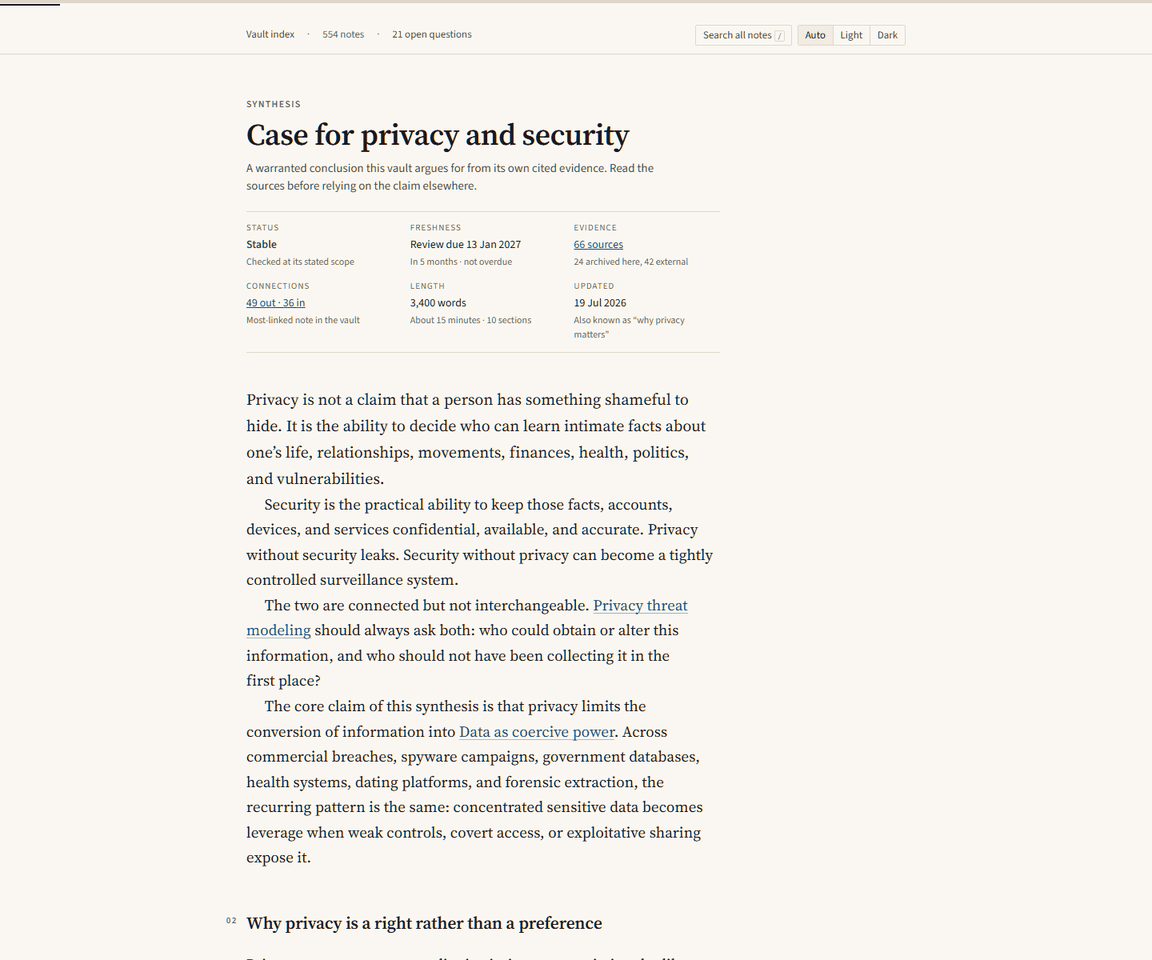
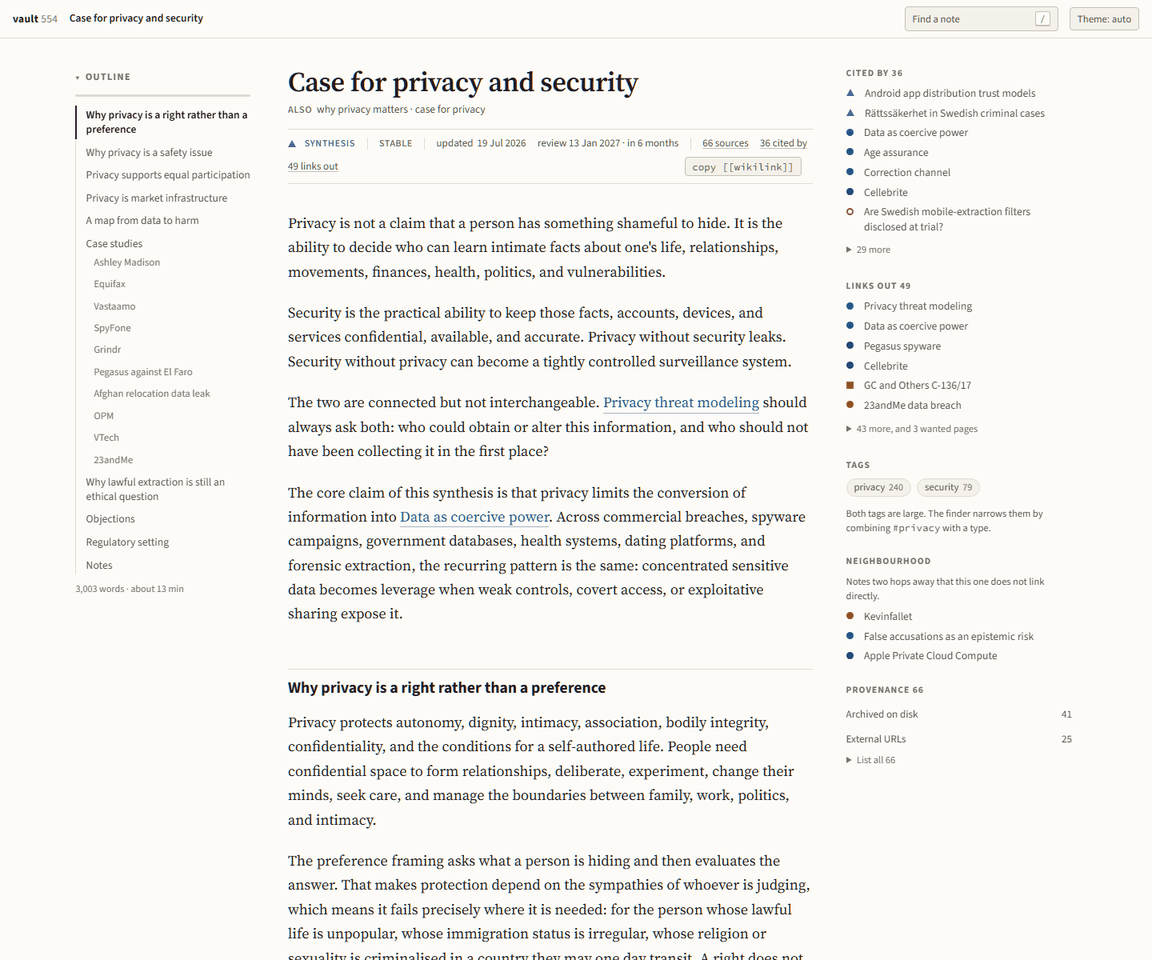
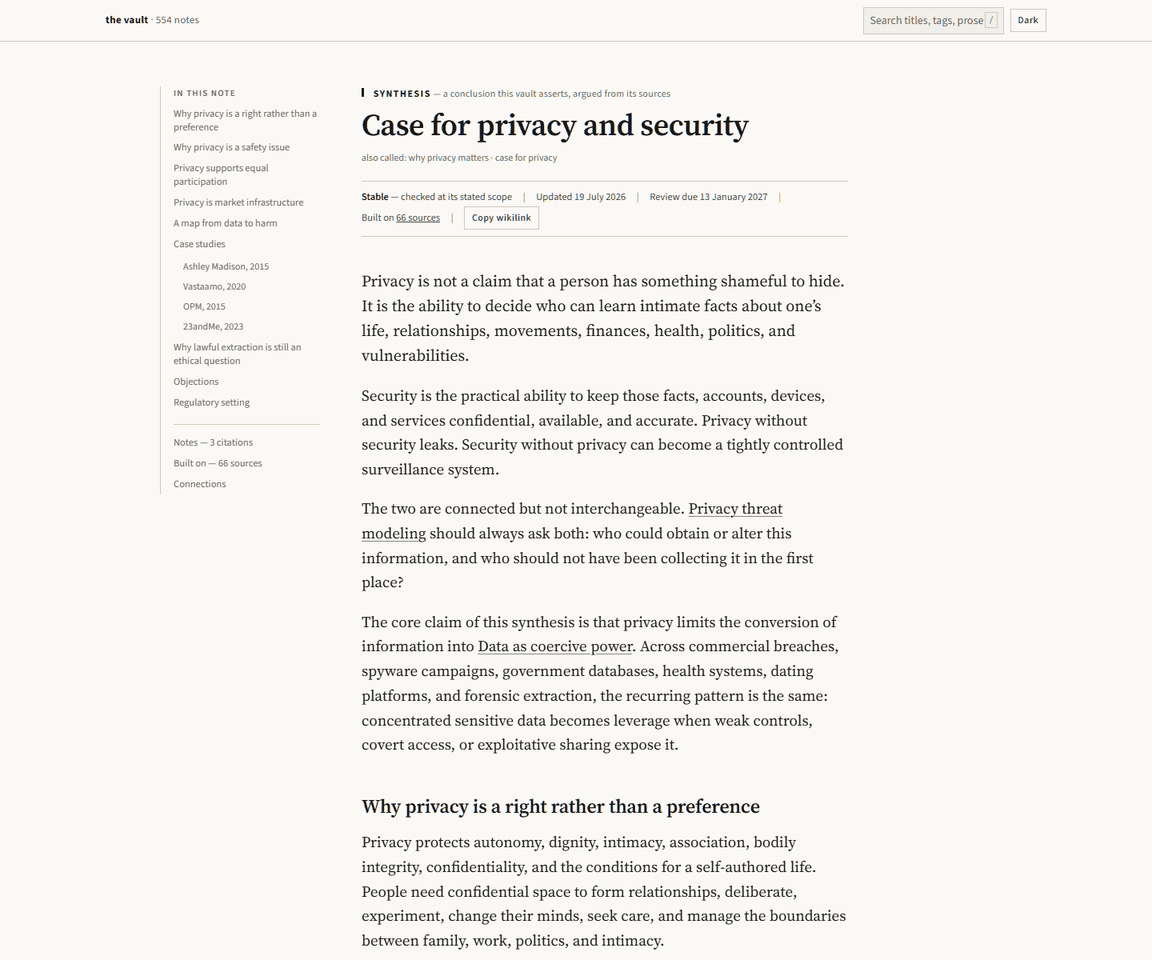
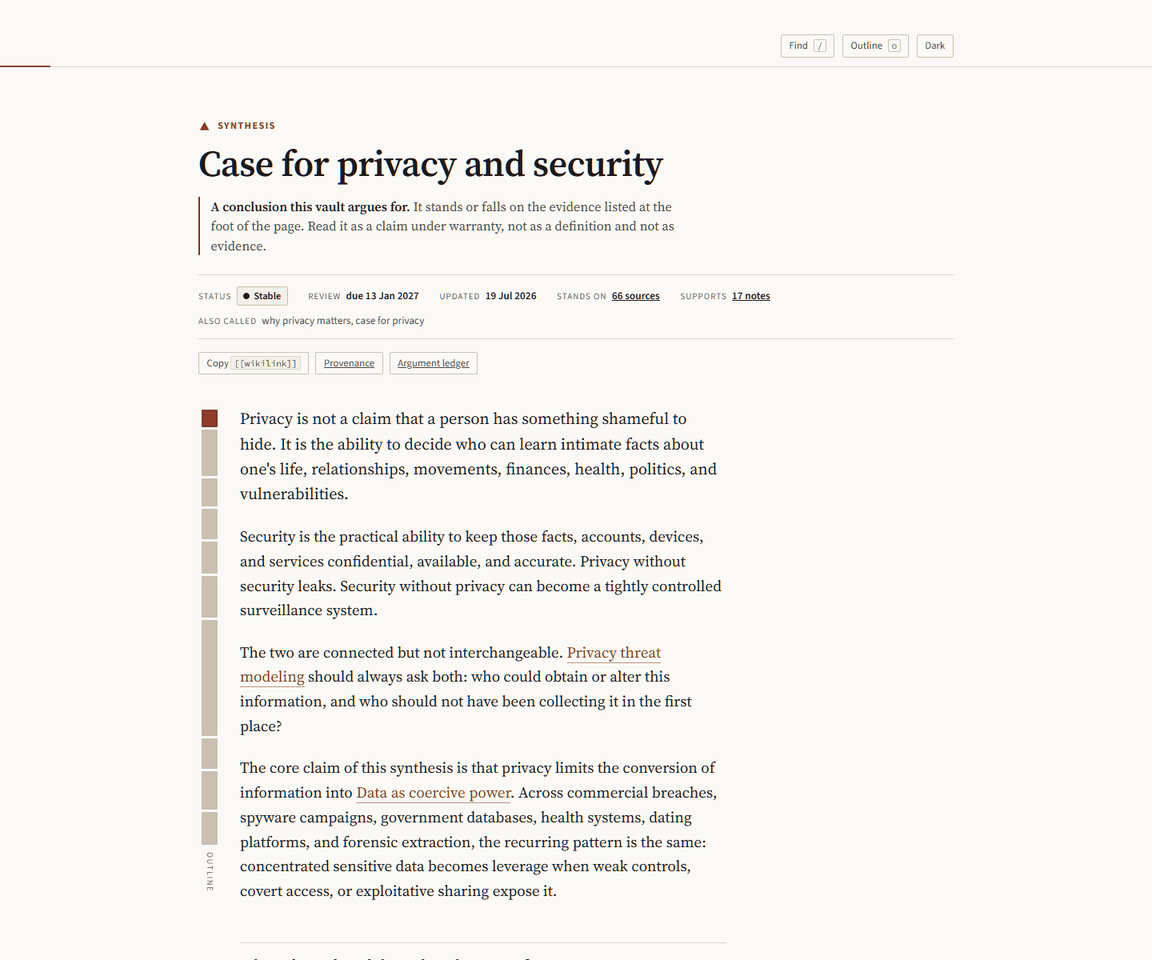
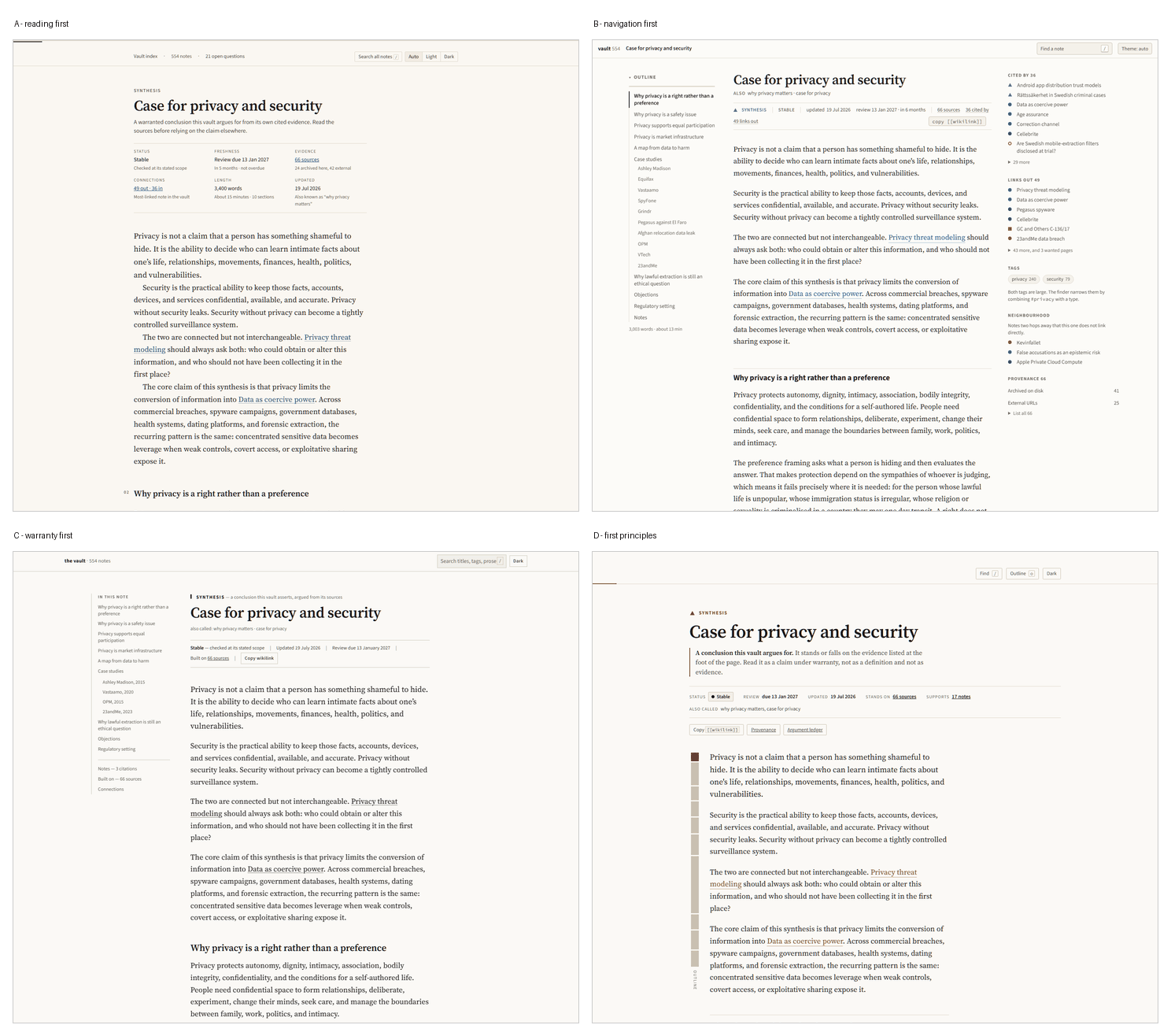
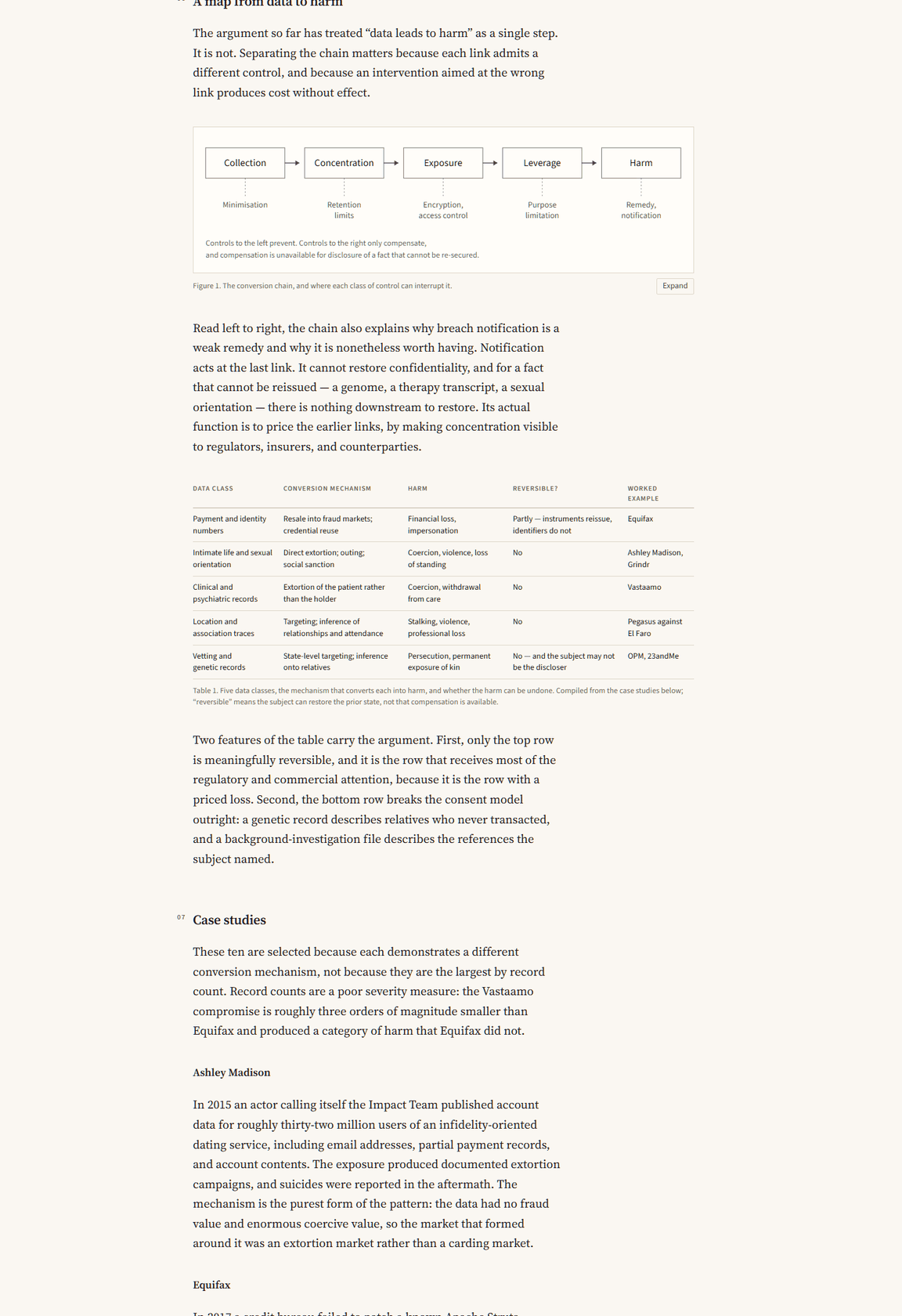
The prototypes set real prose from Case for privacy and security rather than placeholder text, which is what makes them usable evidence about typographic colour at the density the vault actually writes at. The surrounding figures — source counts, backlink counts, neighbourhood lists — are accurate to the vault on the import date but were transcribed from the brief rather than generated, so they illustrate the design without being a live view of it.
Built on 5 sources (5 archived here).
Working out connections…
Sources
Working out the neighbourhood…
Model contributions
Measured by git-blame lines per AI model (101 total).
{"width": 320, "height": 320, "data": {"values": [{"model": "Claude Opus 5", "label": "Claude Opus 5 (100%)", "lines": 101, "share": 1.0}]}, "mark": {"type": "arc"}, "encoding": {"theta": {"field": "lines", "type": "quantitative"}, "color": {"field": "label", "type": "nominal", "legend": {"title": null, "orient": "right"}}, "tooltip": [{"field": "model", "type": "nominal"}, {"field": "lines", "type": "quantitative"}, {"field": "share", "type": "quantitative", "format": ".1%"}], "order": {"field": "lines", "type": "quantitative", "sort": "descending"}}}